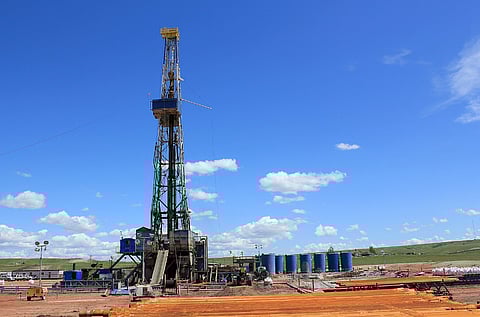

A drilling rig on the prairies
Courtesy Wikimedia Commons
The Canadian Association of Petroleum Producers (CAPP) has released a comprehensive report showcasing the pivotal role of Canada’s oil and natural gas industry in driving economic prosperity, as part of its “Canada Builds” initiative.
The report, unveiled on August 21, emphasizes that the sector supports over 800,000 direct and indirect jobs nationwide, contributing $135 billion annually to Canada’s GDP. It underscores the industry’s resilience and innovation, particularly in Alberta and Saskatchewan, where it remains a cornerstone of local economies.
Some Canadians, particularly in oil-dependent regions like Alberta, fear Prime Minister Mark Carney’s Liberal government, elected on April 28, will impose stricter regulations that could limit oil and gas development, citing his past advocacy for climate-focused policies as Bank of England governor.
Reports indicate concerns that his party might prioritize renewable energy and net-zero targets by 2050, potentially reducing investment in fossil fuel projects and threatening jobs in the sector.
“The Liberals have spent a decade blocking, delaying, and killing Canadian energy,” said Conservative MP Shannon Stubbs.
“Their anti-development policies have driven $600 billion in major projects away from Canada. Now they copy Conservative energy policy and call it their own, give me a break.”
The CAPP report highlights significant investments, with $33 billion committed to new projects in 2024 alone, aimed at enhancing production efficiency and reducing environmental impact. CAPP notes that these projects, including advancements in carbon capture and storage, align with Canada’s climate goals while maintaining energy security.
The sector also pays $25 billion yearly in taxes and royalties, funding public services like healthcare and education across provinces.
However, the report faces scrutiny amid growing calls for a shift to renewable energy. Critics argue that reliance on fossil fuels contradicts Canada’s net-zero ambitions by 2050, pointing to the industry’s historical carbon emissions.
CAPP counters this by showcasing a 28% reduction in greenhouse gas intensity since 2012, attributing it to technological innovations and regulatory compliance. The report also projects that natural gas will play a critical role in the global energy mix, meeting rising demand in Asia and Europe as a lower-emission alternative to coal.
The “Canada Builds” campaign aims to counter negative perceptions by highlighting the industry’s contributions to infrastructure, such as pipelines and roads, and its support for Indigenous economic reconciliation through partnerships.
Yet, some environmental groups question the long-term sustainability of these efforts, urging a faster pivot to green technologies. As debates intensify, CAPP calls for balanced policy support to ensure the sector’s continued viability, positioning it as essential to Canada’s economic future while adapting to a changing energy landscape.
