
Alberta's oil sands contain one of the world's largest petroleum resources, a deposit so vast that energy analyst Kevin Birn says it exceeds all the oil humanity has consumed or produced throughout history.
"There's more oil in the oil sands than mankind has ever produced or used in its entire history," Birn said during an appearance on the Energy Sense podcast produced by S&P Global.
Birn described the oil sands as a mixture of extra-heavy oil, sand, clay and water. He noted that Indigenous peoples were aware of the resource long before industrial development, using bitumen exposed along riverbanks to help waterproof and seal canoes.
As European settlement expanded across North America, interest grew in finding ways to commercially develop the resource. However, the viscous nature of bitumen made extraction difficult.
According to Birn, renewed interest emerged during the Second World War as governments examined domestic energy security. Numerous extraction methods were attempted, but commercial success remained elusive.
The breakthrough came in 1967 with the start of Alberta's first commercial oil sands operation.

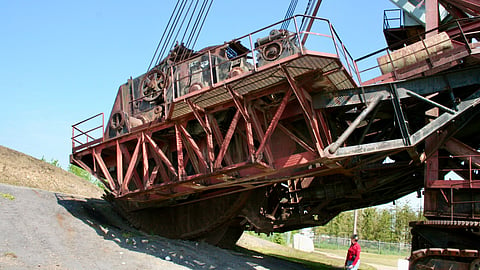
Birn said the oil sands occur in relatively flat geological seams. Where those deposits are close enough to the surface, operators can remove overlying material and mine the resource. The mined oil sands are then processed using hot water and agitation to separate bitumen from sand, clay and water.
Today, the oil sands remain the foundation of Alberta's oil industry. Alberta produced a record 4.1 million barrels of oil per day in 2025, with approximately 84 per cent of that production coming from the oil sands. Based on Alberta Energy Regulator data, that equates to roughly 3.4 million barrels per day of oil sands production.
The scale of the resource remains immense. Alberta reports proven oil sands reserves of approximately 158.9 billion barrels, representing the overwhelming majority of Canada's proven oil reserves.
For much of the industry's early history, production was largely limited to mining operations because only shallow deposits could be economically accessed.
The industry's next major transformation arrived in the early 2000s.
Birn said vast portions of the oil sands resource lie too deep underground to be mined economically. Earlier thermal recovery technologies created steam chambers that required thicker reservoir formations and were unsuitable for much of Alberta's oil sands resource.
That changed with the development and commercialization of Steam Assisted Gravity Drainage, commonly known as SAGD.
Rather than creating spherical steam chambers, SAGD uses horizontal wells to create long linear steam chambers within the reservoir. Birn said the technology unlocked access to enormous quantities of previously inaccessible bitumen and dramatically expanded the development potential of Alberta's oil sands.