
By Ryan Painter
The capital city of British Columbia, Victoria, likes to describe itself as a city of inclusion.
Our elected leaders repeat the language often. They issue statements. They cite values. They offer land acknowledgements. They choose their words carefully for every occasion.
What is missing is something far less performative and far more important: the willingness to enforce basic rules of public order when the target is unpopular in activist circles.
That is why the remarks delivered to Victoria City Council by Sadie Jackson on January 8, 2026 matter.
Jackson is not Jewish. She is a fourth-year university student studying forest ecology. She appeared before council because she believes in the values the city claims to uphold in its Inclusivity Statement, which promises to remove barriers so that everyone can access and fully participate in city services, spaces and programs.
She then said what too many local leaders refuse to state plainly: antisemitism is rising in Victoria, and the response from leadership has been inadequate.
Her delegation, delivered during a public meeting of council, was not a lecture on foreign policy. It was not a demand that people stop caring about war or stop speaking about suffering. She drew a clear and reasonable line. Peaceful political expression is legitimate. Intimidation, harassment, vandalism, assault and calls for violence are not.
That distinction should be straightforward in a country governed by the rule of law.
Instead, it is being blurred in real time.
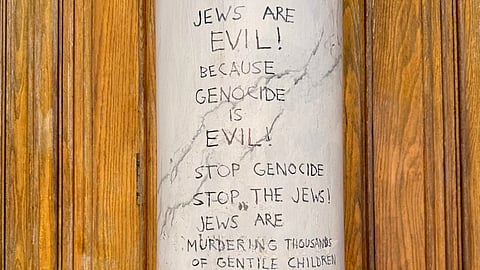
Jackson described a pattern many Jewish Victorians have experienced for nearly two years: repeated desecration of the city’s historic synagogue, harassment and assault of Jewish students, and weekly demonstrations that have crossed the line from protest into intimidation.
One of the most striking details was not the protests themselves, but the fact that police are now repeatedly required to form protective rings around individuals who show support for the Jewish community because of prior incidents of harassment and physical aggression. Fully armed officers guarding Jewish people and places have become part of the city’s new normal.
That should alarm every resident, regardless of political views. If armed police protection is required to attend a family-oriented event at a synagogue, the problem is not “community tension.” It is that something has been allowed to metastasize.
Jackson’s central point was simple: selective enforcement.
Victoria has laws and bylaws governing blocked roads and entrances, as well as criminal prohibitions against assault, harassment, vandalism, uttering threats and incitement. These are not abstract concepts. They are clearly defined offences under Canadian law.
When those laws are enforced inconsistently, the message is unmistakable. The rules apply differently depending on who is targeted and which politics are in fashion.
That is not inclusion. It is permission.
And once permission is granted, it spreads.
It is also important to be clear about what freedom of expression protects, and what it does not.
Peaceful protest, dissent and political speech are essential to a free society. They are protected precisely because they can be uncomfortable or unpopular.
But freedom of expression is not a blanket exemption from the law. It does not include threatening people. It does not include targeting places of worship. It does not include vandalism, assault or physical intimidation. It does not include harassment directed at someone’s identity or religious beliefs.
These distinctions are long established in Canadian law. The problem in Victoria is not confusion about where the lines are drawn. It is that they are being enforced selectively.
When governments fail to enforce these boundaries consistently, they do not protect free expression. They undermine it by allowing intimidation to masquerade as protest and by signalling that some communities are expected to tolerate behaviour others would never be asked to endure.
A city council that cannot articulate this distinction clearly and act on it consistently is not defending civil liberties. It is abandoning one of its most basic responsibilities.
Jackson made four specific requests.
First, that council publicly endorse the International Holocaust Remembrance Alliance definition of antisemitism, which has already been adopted by Canada and many other jurisdictions.
Second, that municipal laws be enforced consistently in cases involving hate and intimidation.
Third, that council issue a clear public statement affirming that antisemitism has no place in Victoria and will not be tolerated. That this has not occurred to date speaks for itself.
Fourth, that members of council abide by the city’s own inclusivity statement and refrain from encouraging or participating in activities that contradict it.
These are not extreme demands. They are baseline expectations in any community that takes its stated values seriously.
This is not unique to Victoria. Across Canada, Jewish communities are watching institutions equivocate, police hesitate, and political leaders hide behind process while antisemitism grows more brazen. When the state fails to protect Jewish citizens consistently, the consequences are not theoretical. They are dangerous.
At the federal level, elected officials have entertained rhetoric and actions that single out Jewish Canadians under the banner of moral activism, further eroding confidence that institutions will act impartially.
If Victoria City Council rejects Sadie Jackson’s requests, it will not be because they are unreasonable. It will be because too many leaders are unwilling to risk displeasing activist factions that have grown increasingly comfortable with antisemitism, so long as it is wrapped in the language of justice.
That is a choice.
It is one no serious city should make.
