
Paid advertisement disseminated on behalf of Arizona Copper and Gold Ltd.
Arizona Eagle Mining Corp.1 is conducting a significant exploration campaign at its past-producing, high-grade McCabe Gold Mine in Arizona.
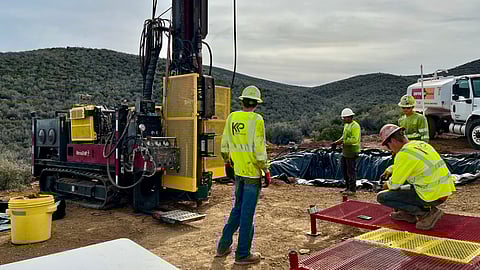
An initial drilling program commenced on January 21, as the company advances toward a public listing anticipated in March/April 2026. The Phase 1 drill program will target extensions of the past-producing McCabe Mine both on strike and at depth.
“We've got a heck of a good starting point,” Arizona Eagle CEO Kevin Reid said in a phone interview with the Westgate Sentinel. “We believe there is significant expansion potential to the McCabe historic estimate, which was defined in 1984 at a gold price of only $360/oz. The deposit was drilled to a depth of only 440m, and ended in high grade mineralization.”
Reid added, “Neighbouring mines have reached depths of over 1,000 metres. Our geological work indicates that we have potential to more than double the strike length. Additionally, we have identified a number of parallel structures that also host small past-producers, but were not historically drilled tested.”

Arizona Eagle Mining will be the result of a reverse takeover (RTO) of Core Nickel (TSXV:CNCO) by Arizona Copper and Gold Ltd. (the private company which holds the Eagle Project). The RTO is expected to be complete by March 2026, and the resulting issuer—Arizona Eagle Mining—is expected to emerge with approximately $6 million in cash and about 50 million shares outstanding.
“Management and the Board have invested about $5 million of our own money” said Reid, a geologist.
Arizona Eagle owns 100 per cent of the Eagle Project in Yavapai County, Arizona, a consolidated land package comprising approximately 300 acres of patented land and roughly 4,250 acres of unpatented Bureau of Land Management mining claims.
The centrepiece of the project is the past-producing McCabe Mine, located entirely on patented land with water rights and existing underground development.
Paid advertisement disseminated on behalf of Arizona Copper and Gold Ltd.
The McCabe deposit hosts a historic high-grade gold-silver resource and was last in production in 1987. Drilling to date extends only to a depth of 440 metres, leaving the system open at depth and along strike.
“We’ve got a lot of ground to explore,” Reid said. “At the McCabe mine, we’ve got three kilometres of strike length and intersections down to 440 metres. We see excellent potential to expand the 1984 resource estimate at McCabe, but have also identified a number of parallel structures through mapping, sampling, and geophysics.”
Between 1980 and 1988, Stan West Mining and later Magma Mining invested approximately US$35 million in exploration, development and mill construction—an amount Arizona Eagle estimates would exceed C$110 million in 2026 dollars.
“Stan West had a production mind set. They sunk a shaft and fast tracked towards mining,” Reid said. “That was their goal, with limited drilling and exploration, they decided to go ahead and sink a shaft to 850 feet and then extended that same shaft (the “Sooner Shaft”) to 1,450’.
"We are encouraged by the high grade, the district scale that we have assembled, but we are taking an exploration approach to both confirm and expand our high-grade gold and silver historic estimate."
Arizona Eagle says modern exploration has significantly upgraded the project’s growth profile. Recent helicopter VTEM surveys, extensive surface sampling, and ground-based induced polarization and resistivity surveys have identified at least 12 parallel and conjugate mineralized structures that were not included in the historic estimate and have never been drill tested.
“At surface, throughout our Eagle Project, which includes the McCabe past producing gold, there are many extremely high-grade gold, silver and copper samples," Reid said.
"In fact, we have multi-percent copper in the 20-plus per cent range—it appears as though we could have two or more volcanogenic massive sulphide (VMS) targets, in particular, one target we are calling our “Eagle Copper Zone."
“The copper zone would be something we're targeting in addition to the multiple mesothermal, McCabe-like structurally controlled precious metals targets. We are in a very well-known, and productive (VMS) belt,” Reid added.
In January 2026, the company started a Phase 1 drill program, targeting extensions of the McCabe deposit as well as newly identified high-priority structures across the broader Eagle Project.
“There are numerous high-grade historical mines all over our project,” Reid said. “These mines follow mineralized trends that look very similar to the McCabe structure, and we have sampled very similar high-grades at surface, but they were not historically drill tested or subject to modern exploration methods.”
The project is located within a prolific historic mining district adjacent to the Iron King VMS mine, which produced approximately 5.7 million tonnes grading 2.6 grams per tonne gold, 91 grams per tonne silver, 4.9 per cent zinc, 1.8 per cent lead and 0.1 per cent copper between 1903 and 1969.
“Nearly one-million ounces of gold was produced at the Iron King,” Reid said. “The Eagle Project has high-grade gold and copper samples at surface, coincident with geophysical anomalies that are conductive. The geological proximity to the Iron King mine is encouraging, as there’s a strong possibility for additional VMS deposits on our claims to the southeast and northwest of the McCabe mine.”
Arizona Eagle has also consolidated additional nearby patented properties, including the Sunol, Palo Alto and Columbia mines, increasing its patented land holdings within a 4,500-acre claim package.
Reid said the drill program is designed to confirm historic grades, test previously unexamined structures and assess the potential to “significantly expand a high-grade gold system using modern exploration methods.”
A 1984 historic estimate* published by Stan West outlined approximately 878,000 ounces of gold grading 11.7 grams per tonne and about 5.1 million ounces of silver grading 69 grams per tonne. This was calculated in gold price environment of US$360-per-ounce gold price. Reported production over two years in the late 1980s totalled roughly 60,000 ounces of gold, leaving the bulk of the historic resource unmined.