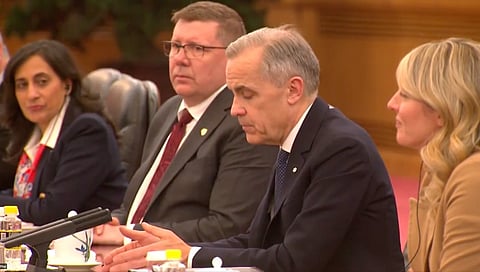

Canadian Prime Minister Mark Carney has touched a sore spot for anti-globalists during meetings in China.
Carney is in Beijing on an official four-day state visit — the first by a Canadian prime minister since 2017 — aimed at resetting and improving bilateral relations after years of tensions.
“I believe the progress we have made in this partnership sets up well for the new world order,” Carney said. Saskatchewan Premier Scott Moe, who joined the delegation, appeared startled by the remark.
Some analysts and users on X have accused Carney of gross inconsistency as he pursues economic opportunities in China amid the collapse of Canada-U.S. relations.
During the English-language federal leaders' debate on April 17, 2025, ahead of the April 28 election, moderator Steve Paikin asked participants: “Let me get ten seconds from each of you on what you perceive to be the biggest security threat to Canada right now. Ten seconds each.”
Carney replied: “We're in a security section. I think we didn't have a chance to talk about anything internationally. I think the biggest security threat to Canada is China.”
What is the New World Order mentioned by Carney — and other politicians before him? Fact? Fiction?
In modern discourse, New World Order carries connotations in conspiracy theories, portraying it as a clandestine plan by elites to establish a totalitarian one-world government through mechanisms like surveillance, centralized digital currencies, and erosion of national sovereignty.
However, in geopolitical contexts like Carney's remarks, it typically signifies pragmatic adaptations to a fragmented international system — such as “variable geometry” alliances — rather than a sinister plot.
Critics argue this shift could undermine democratic norms, while proponents see it as essential for addressing global issues like climate change, trade imbalances, and security threats in an interconnected era.
